Tuesday, September 2, 2008

Week 6 already!! Meeting time

There will be a meeting in the 24/7 Meeting Room to discuss this and next week. There are two meeting times to choose from. UTC 8am Thursday the 4th of September (8pm 4th Sept in NZ) or UTC 9pm Wednesday the 3rd of September (9am 4th Sept in NZ).

So we're focusing in on discussion forums this week, and only for the week. We have been going slowly up until now, spending 2 weeks on the foundation topics. Now we get down to business looking for evidence of community in a range of online environments, and thinking about what facilitation techniques might be appropriate in that context.

So, find yourself a few discussion forums. Preferably open access ones so we can all refer to what you are looking at. Browse Google Groups if you like, but there are many many other forum services to choose from.

Then go back to the question, what is an online community? See if you can settle on at least three indicators of an online community to use to analyse those you are looking at, such as: Has at least 10 active members, has a leader, is current and regular in postings.. (just off the top of my head - yours might be different indicators). Compare and contrast the forums you have found based on the indicators you are using.

Finally, consider the question of facilitation, teaching and moderation.. and make a suggestion of how you might go about facilitating one of the discussion forums you are looking at. What communication skills might you use or not use? Would you use the telephone to contact members of the discussion forum community? Would you email people privately? Would you moderate arguments and delete insulting content? Would you require dialog in the discussion forum - or will announcements be ok. etc.

Good luck, and hope to see you in the meetings.

Wednesday, August 20, 2008

To facilitate, teach or moderate

So begins another 2 weeks considering the semantics of words related to the topics in this course.
"Those who can not say what they mean, can not mean what they say"
Peter O'Toole playing Reginald Johnston in The Last Emperor
In the last 2 weeks we have been considering what it is that makes up a community - particularly an online community. Many of us have focused on Wenger's Community of Practice, but some challenged the notion of CoPs, pressing for an understanding of community regardless of a practice or not. Some have given excellent and thought provoking examples of their experiences with online communities; others have bravely tackled the groups and networks debate set up by Stephen Downes. Of course, it is not a question to be resolved, only one to be explored. By exploring this question together we have all brought perspectives and reference points for each other to consider, and so each of us will develop a preferred understanding to work from. There has been some wonderful blog posts relating to this consideration, and its great to see so much commenting and cross referencing happening.

Don't forget to browse and update your subscriptions with some of the 11 late comer's blogs.

To kick off the next two weeks where we will consider the differences and similarities of the practice of facilitating, moderating and teaching, 12 of us met online (link to recordings). 30 minutes of the meeting was spent on a wonderfully colourful round of introductions, with voices and blog links coming in from many corners of the world, including ElderBob from Texas joining us while he cooked up a stew of crookneck squash! :) We had a great discussion about the meaning of community with some very insightful comments made. I offered some advice for the coming weeks, and encouragement to stick with the course through these semantic periods - the fun stuff will be starting soon enough. I suggested that we each start keeping an eye out for interesting topics and ideas for our facilitation projects for the course mini conference in November.

Apologies to those who made it to the meeting session 13 hours earlier. We did have two time frames listed, and we will continue with that idea so as to give people in the various time zones an opportunity to join in. I was absent due to a delayed flight. I hear a meeting was held and that it went well. Unfortunately there is as yet no recording or account of it.

I hope we all find some interesting links and perspectives over the next 2 weeks. Personally, I find this topic one of the more interesting in the course :)

Wednesday, August 6, 2008

Our meeting and our blogs

17 of us made it to the meeting yesterday. Here's the recording. The course wiki been updated with that link also. It was a pretty good discussion I felt.. there were some quiet moments that I tried to pick up with my rather poorly web conferencing facilitation skills. Thankfully there were some people there who were prepared to jump in and make comment and question things. One that sticks in my mind is Bron's tip on facilitation - "knowing what not to do".

I can certainly relate to this. Often, I will feel so uncomfortable with silence that I will fill the void with my own comments or opinions which may or may not be already more developed than the group that is asking for facilitation. This can have a negative impact on people developing confidence to join in discussions as they might start relying on you as the expert, rather than the facilitator looking to draw expertise and awareness out of people. So, knowing what not to do is critical. As a rule of thumb I have set myself, I will try to respond with more questions than answers, and focus my problem solving skills on making sure the technology us working and that everyone has a chance to be heard.

To that end, I have done my best to create a list of all the people doing the course who have a blog. This should assists us in being able to browse participant blogs and subscribe to ones of interest. I wasn't suitably prepared for the amount of interest in the course and so fumbled the maintenance of the list of people and their blogs, so apologies if you are not on there. Please email me directly if you are not on there but should be.

Initially I was keeping a Google Spreadsheet going (and still am) and keeping it up to date as people introduced themselves through the wiki discussion page. But as people kept joining well into week 1, and others were updating their intro with their blog links, it all kinda got out of hand for me here. I shouldn't have used the Google Spreadsheet until now... Anyway, I've learnt for next time - I will use the wiki for creating the list, and ask everyone to update that list by a certain date, and then generate a spreadsheet from there for my own records.

So, I hope you will access the meeting recording and check the blog list for other blogs of interest to add to your RSS news reader. Remember - don't add them all! just some that are of interest to you - that way it will remain managable for you and chaos for me ;)

Tuesday, August 5, 2008

Orientation complete? What is an online community?

It has been quite a week! The email forum has been going berserk with enthusiasm, confusion, chaos and insights. Reminds me of that moment you first walk into a fun park... trying to do everything at once :) It was good to see all this, and I think we managed to keep a balance in the orientation week's discussions.

The email forum is not a requirement for the course. It is a space for those of us who enjoy discussing the weekly topics and socially constructing our learning. The minimum requirements for the course are listed on the course wiki. In week 1 - Orientation, everyone should have by now set up their own blog, set up an RSS news reader, and introduced themselves to the course wiki with a link to their blogs.

It is now my job to create a list of everyone doing the course with their contact details and blog addresses. This should make it easier for the rest of us to subscribe to each other's blogs. We don't have to subscribe to everyone's blogs - just the one's that interest us. It is my expectation that little networks will naturally form based on what we can make out about each other through our blogs. Some of us will gravitate towards the more technical aspects of what make online communities work, others towards the more human aspects, and so on. So long as we cross reference each other from time to time such as by making hyperlinks to each other's blog posts from our own posts. Through tis linking a good over view of our network forming will emerge - just in time for week 7 - Blogging networks.

As was discussed in week 1 by some of the participants, a tag word for the course is being used as a way to collect and centralise all our dispersed work in this course. FOC08 is a way to label each of our posts so that they can be collected in one place. It is a nice way to quickly come together if any of us are already established online elsewhere and don't want to have to set up a whole new account and space. The search engine technorati is already starting to pick up references to FOC08, and a few of the participants have manually started collecting people's work into the one place for quick reference. To get your blog posts included in those places, just add the FOC08 tag word in the field below where you type up your blog post and it will appear. Its easy networking! I know.. it sounds complicated to those who are not familiar with it.. but it IS a very handy thing for people who are already set up online.. it saves a lot of time.

So, we now begin week 2 and 3 focusing on the question - What is an online community? We are meeting at 3am UTC (That's 3pm NZ time, and other times here). Just click the link to the 24/7 meeting room before that time and you won't need a password to join. A recording will be made available if you can't make it.

Things to do for the next 2 weeks are outlined on the wiki. Please take your time with it, you have 2 whole weeks (10-12 hours) on the question of what is an online communty? I think it is one worth reading up on, discussing in the email forum and posting a response to your blog. Already there has been a promising start to a discussion in the email forum on the subtle differences between blogs and forums for communication. Don't forget to cross reference to other people's posts, and of course to include other reference's in your post that show's you are researching and learning :)

Good luck, and watch this space for updates.. this space being the course blog - add it to your shiny new RSS News Reader ;)

Tuesday, July 29, 2008

Our first meeting

A group of 16 of us met in the Elluminate (24/7 meeting room) today. Here's a recording. (I will make an MP3 of that recording soon. As expected, others had some technical issues and weren't able to make it, others found their way into another meeting room entirely! And the meeting room that we did have dropped its connection for a moment there, which really freaked me out. All that aside though, it was a good meeting and we covered everything that needs to considered for this orientation week.. namely:

  1. Everyone focus on setting up their blog
  2. Updating their introduction on the course wiki with a link to their blog
  3. Setting up an RSS News Reader

These 3 steps are very important if we are to benefit from each other through this course. The wiki entry for this week has help resources on how to do those things if you are new to all this, and the email forum will be a great place to ask questions and get help. Please use them!

Regarding that meeting room. I thought I'd be tricky and set the meeting to begin from the 25 July and run until 24 December. I did this so we would all have constant access to the meeting space if ever any of us needed such a space at a time other than our allocated times. The link to that space will always be the same and is listed at the top of the wiki, and in the links on the course blog. Look for the link that says 24/7 meeting room. I plan to make MP3 recordings of our meetings for people to be able to listen in on commutes etc.

If this meeting room proves to be unreliable, we will move to one of many options. Lets see.

So:

  1. Set up your blogs
  2. Update your intro
  3. Set up an RSS news reader

Monday, July 28, 2008

Making a start!

Well, Welcome all! We have quite a number with us for this course.. 63 people at the time I write this.. most of them coming in at the very last minute and from all areas of the world! I'm bound to have missed people, so please double check my lists.

This afternoon I have been going through the expressions of interest for participating in this course - that being all the introductions made by people to the course wiki - and adding emails to the Google Group email forum.

I wanted to keep email loads initially low for everyone and so I asked introductions to be made on the wiki. If some how you see that your name IS on the Google Group, but NOT on the Wiki introductions, please amend as you see fit. In the end, and at the very least, you want to have yourself on the Google Group email forum, as this is the end point for further instructions, and obviously a space for general discussion. Remember, if you want to keep email to a minimum, you can adjust your membership to any number of options such as daily digest or no email at all. Visit the Google Group archive for further details.

Our first web conference.

The following instructions are repeated in the full course outline on the wiki. (Repeated for importance :)

At 10pm on the 28th of July Universal Time Code (UTC) - That's 10am on the 29th for us in New Zealand (other time zones here and appologies to those who are outside a reasonable hour for the meeting) we will attempt to connect voice to voice for the first time. You can do this by clicking the link to the 24/7 Meeting space about 30 minutes before the time. This will leave you enough time to load the required software (Elluminate) and test the connection (no password required).

This being our first try at connecting via web conference, we should expect that some of us may not be able to connect for various reasons such as workplace security settings, computer set up, hardware or just the mystery of computing and networks. For this reason, the webconference will be recorded so that those that cannot be there can at least access the recording. The 24/7 Meeting room is always open to anyone who wants to use it for there own meetings about this course - perhaps at better times for you... just click the link at the agreed time :)

Other instructions for week 1
(copied from the wiki)
A week spent orientating yourself into the course, the commitment required, the assignments and what else is involved. For those new to this way of learning online, this week will seem daunting. Get through it and the rest of the course will flow for you nicely.

To do

  1. Set up a blog for your weekly work in this course. If you already have a blog, you are welcome to use that so long as you can clearly indicate what posts are for this course. If you are new to blogging, refer to this resource for getting started. If you are based in the Otago region, Otago Polytechnic offers learning support in setting up a blog through its Learning Centre (for enrolled students) and Community Learning Centres (for the wider community).
  2. Attend the web conference meeting room (No password required) at UTC 10pm 28 July (10am 29 July NZST, see World Clock) to discuss the orientation to the course. Please try to introduce yourself to the course discussion page before this meeting begins. This meeting will be recorded and made available directly after if you cannot attend. You can test your computer and network settings prior to the meeting by using the meeting room link any time. Trouble shooting and help at the Elluminate support page.
  3. Post to your blog what you hope to get out of this course. Include any concerns or questions you may have.
  4. Introduce yourself to the course in the discussion page. When you have your blog set up, add your blog's web address to your introduction.
  5. Set up an RSS News Reader and subscribe to the blogs of others in this course. Again, refer to this resource for getting started with an RSS News Reader to subscribe to blogs. More information on RSS available via CommonCraft


Extra resources

Finally

So many thanks for all your interest in this course, I hope it lives up to your expectations and I hope you will give back by making the most of your time with us and these topics. Collectively I am confident we will be a valuable resource for each other. There is a wealth of experiences among us.

You should allow around 5-6 hours per week for the course, if you are going over that time stop and ask yourself why. If its because you are really enjoying the topic or activities, then great. But if its through technical difficulties and just general management of the course requirements, please get in touch with me and we'll see what can be done to help. It shouldn't be a heavy workload. Good luck and enjoy yourself!

Saturday, July 5, 2008

Next course starts 28 July 08. Open participation, all welcome!

Chat Room - A photo by iBoy Daniel

That course we ran last year is coming up again. I've tweaked it quite a bit - free at last from the learning management system it was locked up inside, running in a wiki schedule, backed up by blogs and an email forum.

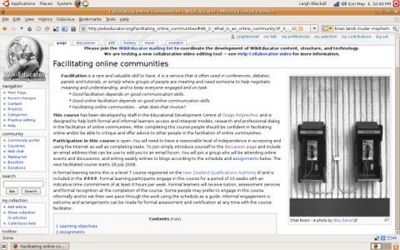
This course has been developed by staff in the Educational Development Centre of Otago Polytechnic and is designed to help both formal and informal learners access and interpret models, research and professional dialog in the facilitation of online communities. After completing this course people should be confident in facilitating online and/or be able to critique and offer advice to other people in the facilitation of online communities.

The next facilitated course starts 28 July 2008.

Participation in this course is open. You will need to have regular access the Internet and be comfortable with independently completing tasks. To join simply introduce yourself to the discussion page and include an email address that can be use to add you to an email forum for the course.

In formal learning terms this is a level 7 course registered on the New Zealand Qualifications Authority. Formal learning participants engage in this course for a period of 10 weeks with an indicative time commitment of at least 6 hours per week. Formal learners will receive concentrated learning support throughout this period, and assessment services and formal recognition at the completion of the course. Some people may prefer to engage in this course informally and to set their own pace through the work using the schedule as a guide. Informal engagement is welcome and arrangements can be made for formal assessment and recognition at any time with the course facilitator.


Contents