Wednesday, October 15, 2008

Wk 10: Looking for online community: Virtual Worlds - 13 - 19 October


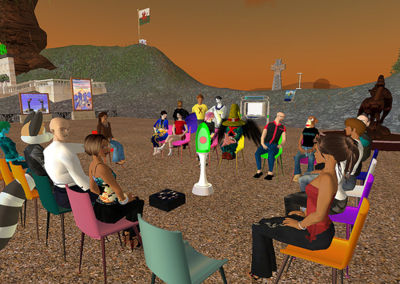
Meeting with Grad Students in Second Life - a photo by Pathfinder Linden Pathfinder Linden spoke at a weekly meeting held by grad students who are using Second Life as part of their academic research. My discussion focused on the importance of research ethics in virtual worlds. Fantastic group of folks, and they have an excellent wiki with more information about their work: http://www.simteach.com/wiki/index.php?title=Second_Life_Grad_Student_Colony
A virtual world is a computer-based simulated environment intended for its users to inhabit and interact via avatars. These avatars are usually depicted as textual, two-dimensional, or three-dimensional graphical representations, although other forms are possible[1] (auditory[2] and touch sensations for example). Some, but not all, virtual worlds allow for multiple users. Wikipedia July 2008.
This week we will be focusing on the use of Second Life as a platform for interaction through an online simulated environment. It is recommended that you access are modern computer and you will need to install the Second Life client to do this week's activities. If you live close to an Internet cafe, they will be able to set you up for an optimal experience

To do

1. Download and install the Second Life client and post to your blog your Second Life user name.

2. Add your Second Life user name to the list of user names for people doing this course.

3. Once you have installed Second Life on your computer click this link taht will start Second Life and log you in directly to Jokaydia. We'll use the 24/7 Meeting room as a backup meeting space. In this meeting you will be shown how to use Second Life and then be taken on a tour of interesting venues and projects in Second Life.

Meeting times

3. Read through the Wikipedia entry for Second Life and conduct your own research into the platform to develop a perspective on what sort of communities exist there. Write a post to your blog with ideas on how you might operate as a facilitator for a community communicating on Second Life.

4. Continue preparations for your facilitated event at the course mini conference

Extra resources

Friday, October 3, 2008

Meeting recording available - preparation for course mini conference

We had a good couple of small meetings earlier this week to discuss preparations for the course mini conference. 7 people made it to the first meeting, and 3 to the second meeting, with about 5 sending in apologies. Here are the recordings of the first meeting.

It is great to see progress already in the preparations for the
course mini conference development wiki


The conference will take place starting the 2nd of November UTC. The week leading up to that date is last minute preparations.

So, for people participating in the course and aiming to do this assignment in the course, you should be arriving on an idea and implementation plan now (ish) and writing it up on your blog. Seek feedback, read other ideas and develop it more before adding it to the conference wiki page. It doesn't have to be a fully formed idea to be added to the wiki, the blog step is so you have a record in your own space, before putting it on the wiki for collaborative development.

Some people have started a new subpage to the conference wiki for their event. This is great and it would be good to see generally over time. But for now, just focus on getting something on the wiki so we can start securing times and dates, and thinking about collaborations.

Tuesday, September 23, 2008

Wk 9: Looking for online community: Wiki collaborators - 22 - 28 September

Jee wiz these weeks just go by so fast! I see that some of us have used the week to catch up a little, or simply get some breathing space, but we need you all back now, because things are about to get interesting...

Why Wikis. CC By blogefl
This week we will begin organising our course mini conference where you will each facilitate an online session. We will use a wiki to coordinate our events, so we can each experience collaboration through a wiki. Online communities through wikis are harder to identify as they usually focus around the creation of content. Wikis usually have a discussion tab with each page, and you can sometimes see community like communication there.

To do

1. Write to your blog the initial ideas you have for your assignment 2 - facilitating your event in the course mini conference. Describe who or what you plan to bring to the group and through what channel of communication.

2. Add your proposed event to the course mini conference web page, and use that wiki page's discussion tab to negotiate and discuss and develop the mini conference. Ie. start a discussion forum thread for your proposed event and discribe your idea in more detail, including any questions or concerns you have that the group may be able to help with. Respond to other people's threads and get the wiki happening.

3. Join in a webconference to discuss the up coming course mini conference and everyone's thoughts and ideas for it. Meeting 1 will be at UTC 9pm 29 September 2008 (what time is that for you?), and meeting 2 will be at UTC 8am 30 September 2008 (what time is that for you?). Both meetings will be in the the 24/7 meeting room.

Extra resources

Wednesday, September 17, 2008

Week 8 - open vs closed is optional

Image: The "Feral Troll" by Benimoto

A few of us met yesterday and we first discussed what we should make of this week. I didn't record it because initially there was just Vida and I, Barbara and Nellie joined later and it took a while for us to actually talk about stuff to do with the course. Basically we all thought it would be OK to set week 8 as optional:

Wk 8: Open versus closed communities - 15 - 21 September

When people first start using the Internet to communicate, collaborate and connect with others they are often worried about the openness of information. There is debate around personal security and client confidentiality. For some an open platform such as a blog or a public email forum is intimidating and makes them feel vulnerable to criticism and predation. Is it just a matter of learning to write for a public forum or are there real issues around privacy in open forums? Is there a place for a closed forum? What are the benefits and the disadvantages of open networking versus closed forums?"

To do

  1. This week is optional. If you are feeling behind, take this week to catch up.
  2. If the open versus closed topic interests you, use the resources below to find your own path into it.
  3. If another topic is of interest to you and something you would like to spend some time on, do that.

Extra Resources

Friday, September 12, 2008

I'm falling behind Week 7 Blog networks

Its almost the end of week 7 where we look into blogging networks and I have only just finished catching up on emails and blogs posts. I realise that I haven't updated my news reader with the feeds of some late comers to the course too! Better do that.

2 things I am noticing over all. We are still tending to blinker our thinking with educator eyes. Most of us have the rest of our working days to think about teaching people we call "learners", how about taking some time out from that way of thinking and considering people as people, and facilitation not as teaching or an educational practice with some kind of learning objective. If you did try and think outside that box for a bit, as Bron has been doing for a few weeks now, I think you will discover ideas that will ultimately inform your teacherly practices, maybe even expand horizons to a possible new role in the community that is not all about learning outcomes. Perhaps listening to the meeting recording from last week will shed light on this line of thinking.

I have also noticed a slight slow down in blog posts, and especially comments and networking with each other. It is a shame to see more and more posts without comments, where as earlier in the course I was amazed by the number of comments helping to keep us stitched together. Naturally we all get busy, especially as the novelty of the course wears off, and it is in part due to the start of the CCK08 course for some of us, but I hope we can all keep up the effort for FOC08 and aim keep it going, networking with and supporting each other as much as possible. It helps us all along and keeps us feeling connected.

Not long now and we will be collaborating in the organisation of an online conference. I wonder how many people we will have with us for that? How many of us have started thinking what we will do for it? and how will we do it. Will we have panels, debates, discussion threads with summaries, photo stories, the development of a wiki document... I wonder?

So early next week I think we should aim to meet online again. I'm thinking Monday UTC at the usual two times.. 8am and 9pm UTC. One thing that really needs discussion at that meeting is what we should do about week 8! It has no instructions!!

Tuesday, September 2, 2008

Week 6 already!! Meeting time

There will be a meeting in the 24/7 Meeting Room to discuss this and next week. There are two meeting times to choose from. UTC 8am Thursday the 4th of September (8pm 4th Sept in NZ) or UTC 9pm Wednesday the 3rd of September (9am 4th Sept in NZ).

So we're focusing in on discussion forums this week, and only for the week. We have been going slowly up until now, spending 2 weeks on the foundation topics. Now we get down to business looking for evidence of community in a range of online environments, and thinking about what facilitation techniques might be appropriate in that context.

So, find yourself a few discussion forums. Preferably open access ones so we can all refer to what you are looking at. Browse Google Groups if you like, but there are many many other forum services to choose from.

Then go back to the question, what is an online community? See if you can settle on at least three indicators of an online community to use to analyse those you are looking at, such as: Has at least 10 active members, has a leader, is current and regular in postings.. (just off the top of my head - yours might be different indicators). Compare and contrast the forums you have found based on the indicators you are using.

Finally, consider the question of facilitation, teaching and moderation.. and make a suggestion of how you might go about facilitating one of the discussion forums you are looking at. What communication skills might you use or not use? Would you use the telephone to contact members of the discussion forum community? Would you email people privately? Would you moderate arguments and delete insulting content? Would you require dialog in the discussion forum - or will announcements be ok. etc.

Good luck, and hope to see you in the meetings.

Wednesday, August 20, 2008

To facilitate, teach or moderate

So begins another 2 weeks considering the semantics of words related to the topics in this course.
"Those who can not say what they mean, can not mean what they say"
Peter O'Toole playing Reginald Johnston in The Last Emperor
In the last 2 weeks we have been considering what it is that makes up a community - particularly an online community. Many of us have focused on Wenger's Community of Practice, but some challenged the notion of CoPs, pressing for an understanding of community regardless of a practice or not. Some have given excellent and thought provoking examples of their experiences with online communities; others have bravely tackled the groups and networks debate set up by Stephen Downes. Of course, it is not a question to be resolved, only one to be explored. By exploring this question together we have all brought perspectives and reference points for each other to consider, and so each of us will develop a preferred understanding to work from. There has been some wonderful blog posts relating to this consideration, and its great to see so much commenting and cross referencing happening.

Don't forget to browse and update your subscriptions with some of the 11 late comer's blogs.

To kick off the next two weeks where we will consider the differences and similarities of the practice of facilitating, moderating and teaching, 12 of us met online (link to recordings). 30 minutes of the meeting was spent on a wonderfully colourful round of introductions, with voices and blog links coming in from many corners of the world, including ElderBob from Texas joining us while he cooked up a stew of crookneck squash! :) We had a great discussion about the meaning of community with some very insightful comments made. I offered some advice for the coming weeks, and encouragement to stick with the course through these semantic periods - the fun stuff will be starting soon enough. I suggested that we each start keeping an eye out for interesting topics and ideas for our facilitation projects for the course mini conference in November.

Apologies to those who made it to the meeting session 13 hours earlier. We did have two time frames listed, and we will continue with that idea so as to give people in the various time zones an opportunity to join in. I was absent due to a delayed flight. I hear a meeting was held and that it went well. Unfortunately there is as yet no recording or account of it.

I hope we all find some interesting links and perspectives over the next 2 weeks. Personally, I find this topic one of the more interesting in the course :)